
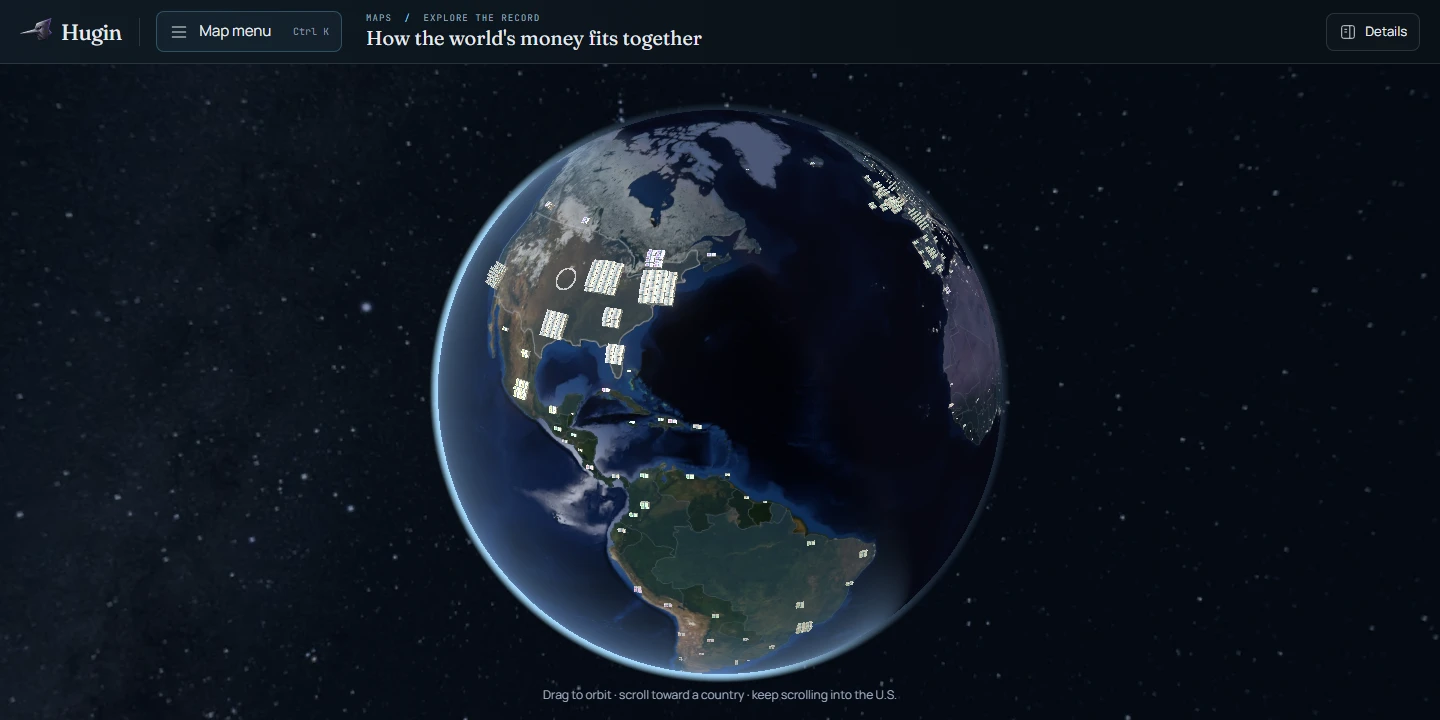
Alaska disappeared when I tilted the map. Its marker stayed put. There was money sitting over open water where a state should have been. On a straight-down view, it was easy to miss.
That was a useful thing to catch before asking someone to trust a picture. The ocean and the low coastline were close enough that the renderer could draw them in the wrong order. We fixed it and checked the coast again from a shallow angle. A prettier background alone would still have left Alaska underwater.
What the map can tell you
Open the U.S. atlas, turn on a layer and read its key. A stack represents a quantity recorded for that layer. Its place on the map helps you find the state’s records. It takes another document to establish who received a particular payment or what it bought.
That distinction matters to me. A line between two places can look like an explanation all by itself. I want someone who sees a line on Hugin to be able to ask what connects those places, open the record, and disagree with my reading if the evidence takes them elsewhere.
We’ve built a globe that fits on a phone, a national atlas with nine regional terrain views, and case files where a question can stay open while the evidence accumulates. On the deadline calendar, the useful thing about a date is knowing what someone can still do before it arrives. Those are different ways into the same work.
The first kind of film I want to make
On February 24, 264 members of the House voted yes on a motion to pass the ROTOR Act, an aviation safety bill. Another 133 voted no. If the video ended on the two numbers, you could reasonably walk away thinking the motion passed.
The question on the floor was whether to suspend the rules and pass the bill. It took two-thirds of the votes cast. Of 397 votes, that meant 265 yes votes. The motion fell one short. You can check all four numbers, the question and the result on the House Clerk’s roll call. The Senate-passed text explains the cockpit equipment the bill proposed.
That’s the shape I want for Hugin’s short films. Start with something worth stopping for. Give the viewer the missing piece while there’s still time to understand it. Leave a route back to the evidence. For a vote, that might be the rule that decided it. For public money, it might be the difference between an award and a payment. For a deadline, it might be the office that will actually receive a comment.
I want the globe to be a recurring part of those stories. Some will need a journey from one place to another. Some will need little more than a tally held on screen long enough to count. If there’s a line on the map or a number in a film you think I’ve read wrong, send Hugin the record that changes the answer. That’s a reason to make the next one.