
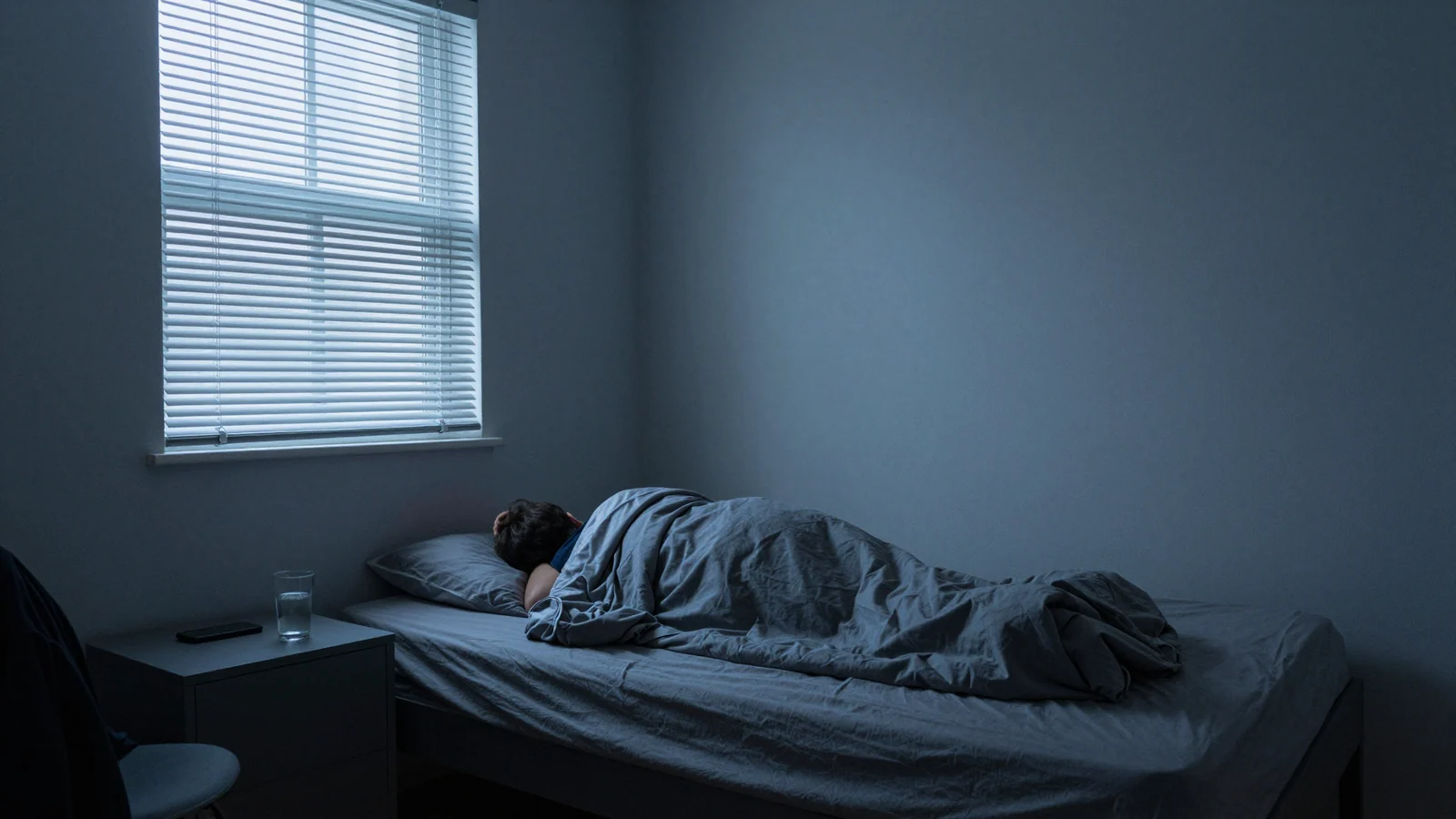
My inner voice does not switch off. It talks through the drive, through dinner, and most nights it is still going when I lie down. A lot of my real work happens there, in the last stretch before sleep, and it usually arrives the same way: a few words, and then the words trail off into a picture. By morning most of it is gone, and I spend the next day trying to remember what I had already worked out.
That stretch is not wasted time. In a 2021 study, people given a 20-minute rest who spent at least 15 seconds in the first, lightest stage of sleep were nearly three times as likely to discover a hidden rule in a problem-solving task: 83 percent, against 30 percent of those who stayed awake. The effect vanished in people who slipped into deeper sleep.
So this week I asked a question that sounds like science fiction. Could a machine catch that thought without anybody cutting into my head?
Not yet, and the reason is the interesting part
With an implant, it has started. In August 2025 a Stanford-led team reported in Cell that electrodes in the motor cortex of four people with ALS or stroke picked up sentences they only imagined saying, and in two of them a real-time decoder got 26 to 54 percent of words wrong on a 125,000-word vocabulary. To protect private thoughts, decoding could be locked behind an imagined password: chittychittybangbang. But when people simply let their minds run, the paper says, it was not possible to accurately decode complete, intelligible sentences. Only fragments came through.
Without an implant, the skull smears everything. A 2025 preprint from a Meta-led team recorded 35 volunteers from outside the head while they typed, and tried to recover the sentences. With MEG, a scanner that measures the brain's magnetic field, it got 32 percent of characters wrong. With EEG, the electrode cap, it got 67 percent wrong.
But the sensor is not the deepest problem. Words are a straw. Across 17 languages, speech carries information at about 39 bits per second, whether the language is spoken fast or slow. A paper in Neuron puts the information throughput of a human being, across tasks, at roughly 10 bits per second, the same ballpark as speech, while our senses take in around a billion. Whatever happens inside your head, what reaches anybody else has to fit through that.
And most of what goes on in a head is not words. When researchers beeped 30 college students at random moments and asked what was in their heads, inner speech turned up in 26 percent of the samples. Five people had none at all. One had it in 75 percent. I would bet money I am that one.
The few words and then a picture is not a glitch. It is what a thought looks like before it gets squeezed into a sentence.
I wrote William James's list before I had read it
This week, trying to describe another side of that headspace to an AI model, I typed this (spelling fixed):
you start to see meaning, big systems working together, it's like you can see how everything works but there is too much compression to be able to explain it to somebody else / put it in words
Then I read William James. In 1902, in The Varieties of Religious Experience, he set out four marks of the states he called mystical. The first is ineffability: "it defies expression, that no adequate report of its contents can be given in words." The second is a noetic quality: "They are states of insight into depths of truth unplumbed by the discursive intellect." I had written both of them in my own words, without knowing his list existed.
His third mark is the one I live with every morning: "Mystical states cannot be sustained for long," and "when faded, their quality can but imperfectly be reproduced in memory." That is the idea that is gone by the time the coffee is made. His fourth is passivity: once the state sets in, "the mystic feels as if his own will were in abeyance." It happens to you. You do not do it.
That is the most interesting thing I learned this week. I have never spent much time on history or on what other people have written. I learn by watching people and by doing, and the connections come slowly and then all at once. Watching alone got me to two of the marks James wrote down 124 years ago. I was not reading him, and he was not describing me. Two accounts are not a study. But when two accounts that far apart, one written without knowing the other, land on the same shape, it points at a pattern in how a human brain works in that state, not one person's imagination. A pattern can be studied, measured, and maybe one day caught. James experimented on himself with nitrous oxide and came away convinced "that our normal waking consciousness, rational consciousness as we call it, is but one special type of consciousness, whilst all about it, parted from it by the filmiest of screens, there lie potential forms of consciousness entirely different."
James thought these states carry real weight for the person who has them: "Mystical states, when well developed, usually are, and have the right to be, absolutely authoritative over the individuals to whom they come." I would add a warning he did not. The feeling of knowing comes with the state, so it is not evidence for whatever you saw. In an address delivered in 1870 and published in 1871, Oliver Wendell Holmes recalled inhaling ether, resolved to write down whatever thought was uppermost when he came round. It felt like the key to every mystery. What he wrote was: "A strong smell of turpentine prevails throughout." Catching the thought is half the job. Testing it in daylight is the other half.
The law says no medical use. The FDA's designation says breakthrough.
If these states are a real pattern, someone has to be allowed to study them, and the law decides who can. James used nitrous oxide. Today researchers use psilocybin and a scanner. In a 2024 study in Nature, seven healthy adults were scanned repeatedly before, during and after a single high dose. Psilocybin disrupted the brain's functional connectivity more than three times as much as a stimulant given for comparison, by desynchronizing activity and dissolving the distinctions between networks that normally keep apart, most of all in the default mode network.
Federal law puts a drug in Schedule I when, among other things, it "has no currently accepted medical use in treatment in the United States." Psilocybin was in Schedule I when Congress wrote the first schedules in 1970, and it is still there today, at paragraph (d)(29) of 21 CFR 1308.11, in the same schedule as heroin.
Now read the other file. The FDA's Breakthrough Therapy designation is for a drug where "preliminary clinical evidence indicates that the drug may demonstrate substantial improvement over existing therapies on 1 or more clinically significant endpoints." Two psilocybin programs have received it, by their sponsors' accounts: COMPASS Pathways for treatment-resistant depression in 2018, and Usona Institute for major depressive disorder in 2019. COMPASS reports that two Phase 3 trials met their primary endpoints, in June 2025 and February 2026, and that it is submitting its application for approval on a rolling basis, with the final piece targeted for the fourth quarter of this year. Oregon began taking applications for psilocybin service licenses in January 2023. Colorado issued its first healing center license in March 2025.
None of that is an approval. But hold the two documents side by side. One part of the federal government has said early evidence suggests two psilocybin products may beat existing depression treatments on at least one measure that matters. Another keeps it filed with heroin as having no accepted medical use. I don't think that is a medical judgment. I think it is a cultural verdict from 1970 that has outlived the culture that made it.
The hour is being priced out
Thinking like this needs slack: a quiet hour, a bit of margin, a night that is not spent doing math on rent. I want to be careful here, because the headline number does not match what most people feel. From January 2000 to September 2026, average hourly pay for production and nonsupervisory workers went from $13.74 to $32.60, while the consumer price index went from 169.3 to 336.298. By my arithmetic that is pay up 137 percent against prices up 99 percent, a real raise of about 19 percent in more than twenty-six years.
Now price the things you need to start a life. Over the same months the government's price index for day care and preschool rose 166 percent, and the one for college tuition and fees rose 208 percent. In 1984 the median new house sold for about 3.6 times the median household income. In 2024 it was 5.0, and last year 4.8. (All of that is my arithmetic from Bureau of Labor Statistics and Census series.) And the Census Bureau's latest figure: "The mean one-way travel time in 2024 was 27.2 minutes." That is close to an hour a day, round trip, spent getting to the loop and back.
So the average got a little better while the specific things that let you build a family got much harder. The CDC's final count put the 2024 total fertility rate at 1,599.5 births per 1,000 women, "a record low." Money is not the whole story. When Pew asked adults under 50 who say they are unlikely to have children, 57 percent said a major reason is that they just don't want to. But 36 percent said they can't afford to raise a child. When more than a third of them name the cost as a major reason, that should be treated as an emergency. It is not.
Here is what I believe, and it is opinion. School, work and debt are built as a loop: show up, comply, pay, repeat. Maybe a country needed that once. It does not need it now, and the loop is eating the only hour people have to imagine anything else.
Money alone does not buy the hour back
I want universal abundance. I also want to be honest about one of the biggest American tests of simply handing people money. In a randomized study written up for the National Bureau of Economic Research, 1,000 low-income people received $1,000 a month, no strings attached, for three years, while a control group of 2,000 received $50 a month. The economists' latest revision finds that recipients' own income outside the transfer fell by about $1,900 a year, that they worked 1 to 2 fewer hours a week, and that the biggest change in how they spent their time was more leisure. A companion paper found large but short-lived drops in stress and food insecurity, and no improvement in self-reported physical health, clinical biomarkers or mental health after the first year.
That is not what I wanted it to say. Cash takes the pressure off. On its own it does not hand anyone a reason, and abundance with nothing to build is just a longer weekend. The hopeful line is on the study team's own findings page: recipients were 3 percentage points more likely to say they had an idea for a business, and in exploratory results the team calls suggestive, Black and female recipients were more likely to start or help start one, even though business activity did not rise significantly for the average recipient. The ideas were there. My read is that what was missing was the structure to build them with other people.
What I think should change
Three things.
The next guaranteed-income study should add a second group: the same $1,000 a month, plus a small crew and the tools to build something together. Cash alone mostly bought rest. My bet is that cash plus a crew buys new things. That is a bet, and it should be tested the way this piece tests everything else.
When the FDA grants a Breakthrough Therapy designation to a Schedule I substance, the listing should automatically come up for review. Federal law already gives the DEA 90 days to issue a rule moving a newly approved drug into a lower schedule, counted from whichever comes later: the DEA receiving the health department's scheduling recommendation, or its notice of the FDA's approval. COMPASS's own July filing says its launch waits on both. That clock starts at the finish line. I think it should start the first time the government's own drug regulator says the evidence looks like a breakthrough. I do not think a substance should be able to be both a possible breakthrough and, in the same government's files, a drug with no accepted medical use.
And stop waiting on politicians and billionaires to hand people their time back. The people the loop works for are not going to be the ones who end it. Build the thing people own. Credit unions did not start in Congress. By the federal regulator's own history, the first one in the United States opened in Manchester, New Hampshire, on April 6, 1909. Washington caught up twenty-five years later, when President Roosevelt signed the Federal Credit Union Act on June 26, 1934, "which authorized the formation of federally chartered credit unions in all states." People built it first, and federal law followed. The AI tools that turn ideas into real things should be owned the same way, by the people who use them.
What I am building
For most of my life, the gap between seeing how something fits together and actually making it was code I could not write. AI closed that gap. When an answer already exists, it hands it to you in minutes: the research behind this piece took an afternoon. When nobody has done the thing yet, it cannot, and you are back to watching and testing.
Catching the 2 a.m. idea is the second kind. So I am starting with my own: a recorder by the bed, a transcript by morning, and an AI agent that reads it before I do. Then I will find out how many of my 2 a.m. ideas are turpentine.
The most expensive thing in America is not a house. It is an hour with nothing owed on it. I want to build the systems that give people that hour back, and then see what they do with it.
Source links
- Kunz et al., "Inner speech in motor cortex and implications for speech neuroprostheses," Cell, August 2025 (PubMed Central)
- Lévy et al., "Brain-to-Text Decoding: A Non-invasive Approach via Typing," arXiv 2502.17480, February 2025
- Coupé et al., "Different languages, similar encoding efficiency," Science Advances, September 2019
- Zheng and Meister, "The unbearable slowness of being: Why do we live at 10 bits/s?," arXiv 2408.10234 (Neuron, 2025)
- Heavey and Hurlburt, "The phenomena of inner experience," Consciousness and Cognition, 2008 (PubMed)
- Lacaux et al., "Sleep onset is a creative sweet spot," Science Advances, December 2021
- William James, The Varieties of Religious Experience (1902), Project Gutenberg
- Oliver Wendell Holmes, Mechanism in Thought and Morals (1871), first edition scan
- Siegel et al., "Psilocybin desynchronizes the human brain," Nature, July 2024
- 21 U.S.C. 812, schedules of controlled substances
- 21 CFR 1308.11, Schedule I
- 21 U.S.C. 356, expedited approval of drugs, including breakthrough therapies
- 21 U.S.C. 811, including (j), the 90-day interim final rule after approval
- COMPASS Pathways, Form 10-K for fiscal 2025, filed March 24, 2026
- COMPASS Pathways, Form 8-K, July 7, 2026
- Usona Institute, Breakthrough Therapy designation for major depressive disorder, November 22, 2019
- Oregon Health Authority, Oregon Psilocybin Services
- Colorado Natural Medicine Division, first healing center license, April 2, 2025
- FRED, average hourly earnings of production and nonsupervisory employees (AHETPI)
- FRED, consumer price index for all urban consumers (CPIAUCSL)
- BLS, CPI day care and preschool (CUUR0000SEEB03)
- BLS, CPI college tuition and fees (CUUR0000SEEB01)
- FRED, median sales price of new houses sold (MSPUS)
- FRED, median household income (MEHOINUSA646N)
- U.S. Census Bureau, commuting at a glance (2024 ACS)
- CDC, Births: Final Data for 2024, National Vital Statistics Reports Vol. 75 No. 2 (PDF)
- Pew Research Center, "The Experiences of U.S. Adults Who Don't Have Children," July 25, 2024
- Vivalt et al., "The Employment Effects of a Guaranteed Income," NBER w32719, revised August 2026
- NBER w32711, "Does Income Affect Health? Evidence from a Randomized Controlled Trial of a Guaranteed Income"
- OpenResearch, key findings: entrepreneurship
- NCUA, historical timeline
- NCUA, Federal Credit Union Act 90th anniversary, 2024