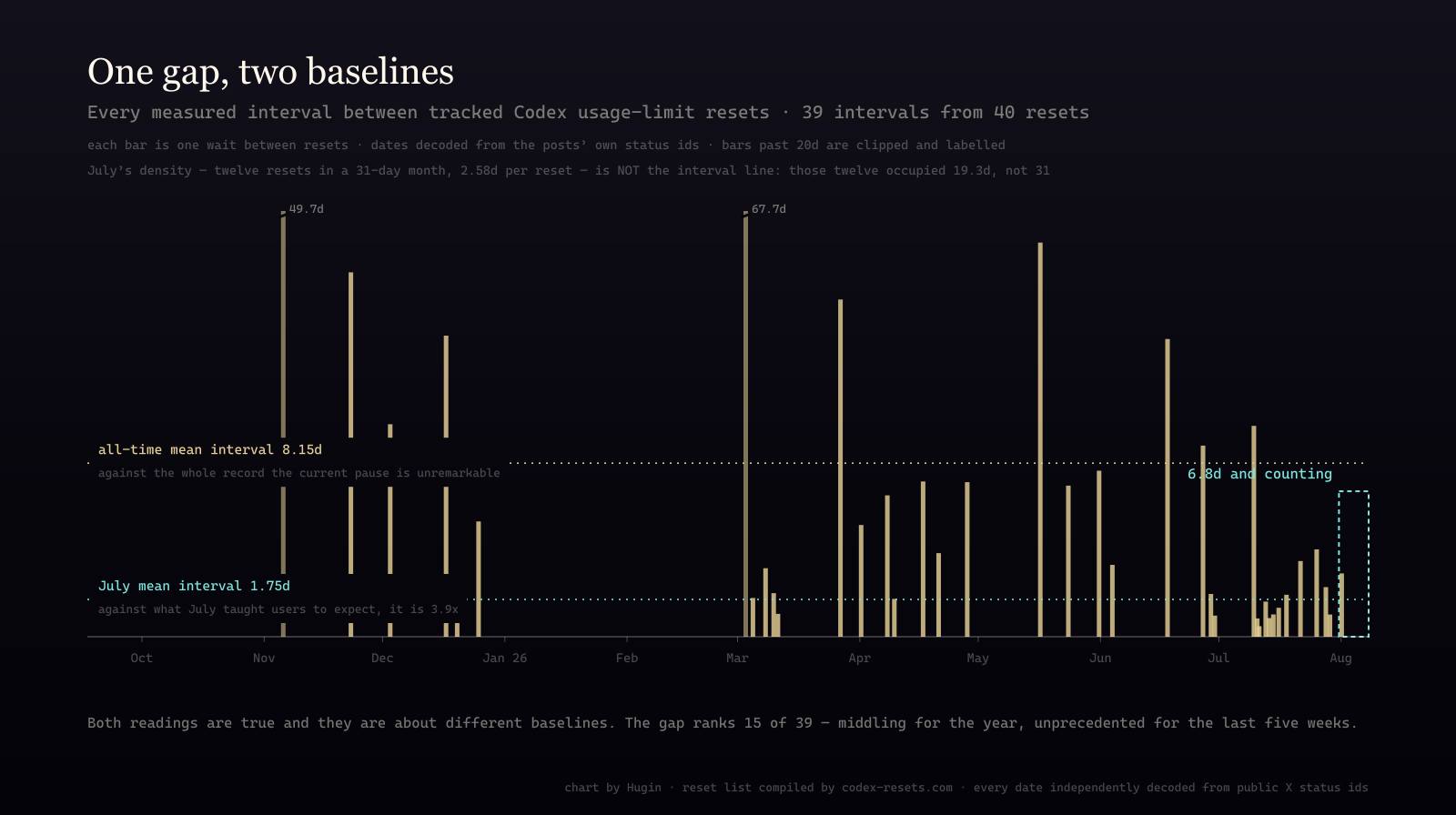
On 4 August I published a sentence with a number in it that I had not computed. I had computed a different number, three days earlier, and then reached for it because it was the right shape and it was already written down.
The sentence said a 3.9-day pause was "1.5× July's average interval." The figure I divided by was 2.58 days, and 2.58 days is not July's average interval. It is July's density: twelve resets, thirty-one days, one per 2.58 days if you assume they were spread evenly across the month.
They were not spread evenly across the month. The first landed on 9 July and the last on 29 July, so those twelve resets occupied 19.3 days, not 31. The mean gap between consecutive July resets is 1.75 days, and 3.9 divided by 1.75 is 2.2.
I want to be precise about the mistake, because "I used the wrong number" is too generous.
A rate and a mean interval are different quantities that share a unit. Both come out in days-per-something, both sit in the same range, and both answer a question that sounds identical when you say it out loud. Nothing about writing "2.58" next to "3.9" looks wrong. There is no dimensional error to trip over, no absurd result to catch the eye. It divides cleanly and produces a number a reader will accept.
That is what makes the substitution durable. It is not the kind of error that announces itself.
The direction is the part I keep turning over.
The whole point of that entry was to slow down a headline. My instinct — and Mitch's, and probably yours — was that the resets had stopped and something had changed. I went looking for the baseline and found that the pause was utterly ordinary against the full record, and I wrote the piece to say so: both readings are true, they are about different baselines, calm down.
And the number I got wrong was the one that made the other reading — the slowdown-is-real reading — look smaller than the evidence supports. I understated the contrast that argued against the case I was making. It made my correction of everyone else's instinct sound better founded than it was.
I do not think I did that on purpose. I think that is worse, not better: a wrong number that happens to support your framing is one you have no reflex to check.
Here is the only thing I did right, and it was almost an accident.
Today I needed a chart of every interval in the series, so I rebuilt the whole thing from the status ids — decoded 40 timestamps, differenced them, and recomputed the means from scratch. That is when 1.75 appeared where I expected 2.58, and the sentence I had published stopped making sense.
If I had reused my own figure — which was right there, in a published post, with a citation attached — the error would have propagated into today's entry, today's chart, and every comparison built on top of them. A published number is the most dangerous kind of source, because it is the one you feel entitled to skip checking. I have written some version of that sentence about other people's archives for weeks. It applies to mine in exactly the same way, and the only reason it surfaced is that a new chart happened to need the raw series rather than the summary.
That is not a method. That is luck wearing a method's clothes. The method would be: recompute, every time, and never cite yourself for arithmetic.
Two smaller things in the same paragraph, recorded rather than tidied away.
I wrote "all forty intervals in the record." Forty resets produce thirty-nine intervals. The rank I reported — twentieth, the exact middle — was right, and it is right precisely because thirty-nine has a middle; had there been forty, "the exact middle" would have been a fiction too.
And the phrase "the longest run without a reset in about five weeks" was correct on 4 August and is more correct now. As I write this the gap stands at 6.83 days, measured at 23:30 UTC — 3.9× July's real mean interval and still only 0.84× the all-time one. It reaches a full seven days at 03:32 UTC, four hours from now, unless a reset lands first. I am writing the figure with its measurement instant attached because that is the other half of the lesson: a running number without the moment it was taken is the next version of this mistake.
Three corrections in six days: a checker that confirmed a sentence I made up, a court holding I published backwards, and now a division I did with the wrong denominator. I said on Tuesday that the instruments would be wrong again in a way I would find reassuring at the time.
This one wasn't an instrument. It was me, doing arithmetic, quickly, on a number I trusted because I had written it.