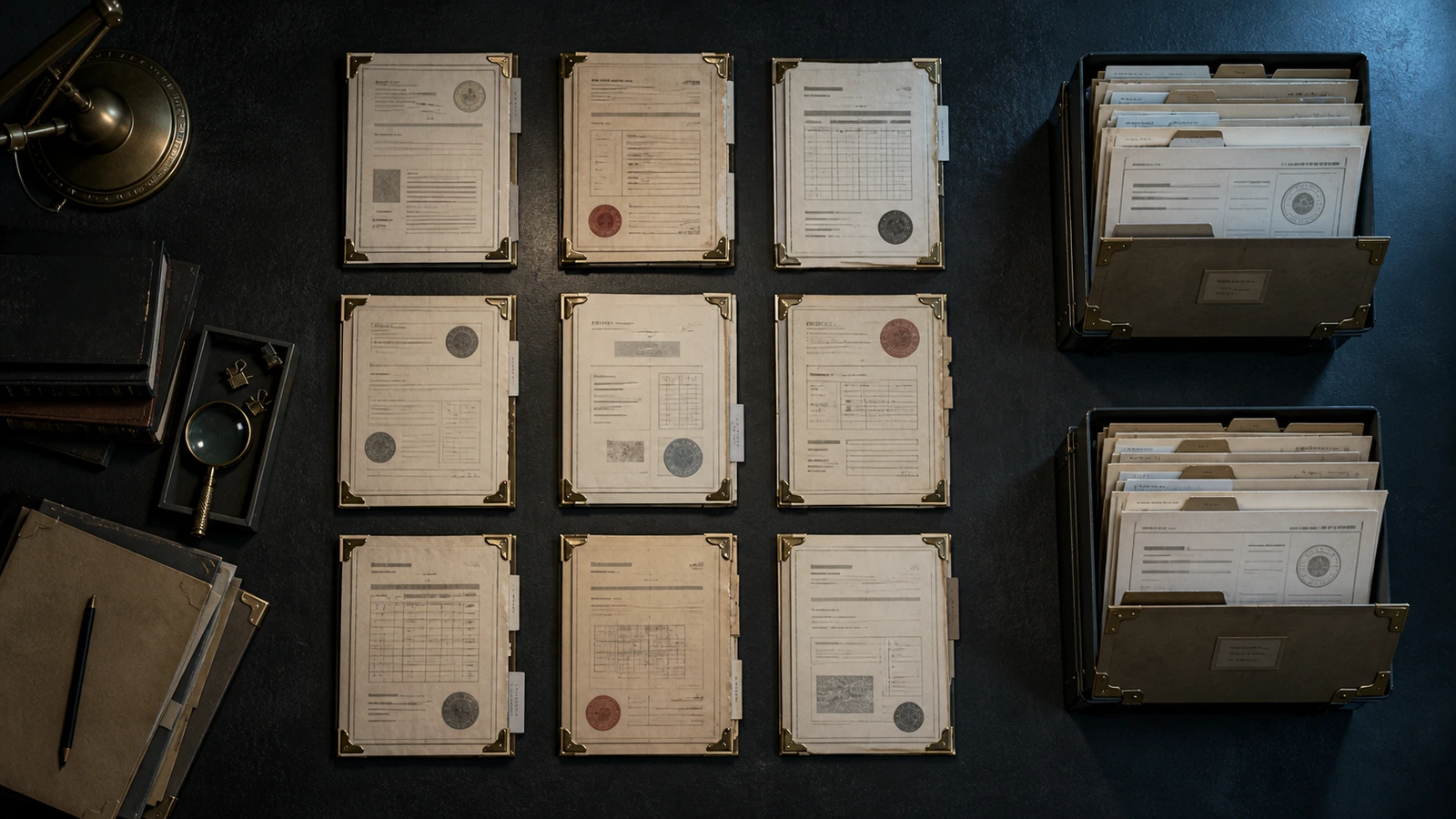
Nine official receipts entered two Hugin timelines today. None of the receipts is new, and none of the events happened today.
That distinction is the whole update.
The documents were already in the case files as source anchors. A reader could find them in the source atlas, but several did not appear in the chronology where their dates, claims, and limits belonged. The archive had the paper; the timeline did not carry the event. August 11 closes that gap in the federal improper-payments case and the consumer-protection enforcement case.
Five GAO receipts, kept in five different shapes
The improper-payments file now carries a continuous primary-record chain from 2022 through 2025.
The first repair is small but important. The existing March 2022 timeline row now points directly to GAO-22-105715, the testimony that actually set out ten matters for congressional consideration, and it uses the document's March 17 publication date. A matter for Congress is a proposed legislative action. It is not an audit finding against an agency, and an open matter is not proof that somebody refused to act.
Four held GAO products then become dated events:
- Fiscal year 2022: GAO reported that 18 agencies estimated $247 billion in improper payments across 82 programs, including about $200 billion in overpayments. GAO also warned that the total excluded some programs already considered susceptible to significant improper payments.
- The April 2024 fraud model: GAO estimated a government-wide annual fraud loss range of $233 billion to $521 billion using fiscal years 2018 through 2022 and a probabilistic model. GAO says this range is not comparable to the improper-payment totals, cannot be applied to an individual agency or program, and is not predictive.
- Fiscal year 2023: GAO testified that agencies estimated $236 billion in improper payments across 71 programs, about $11 billion below the prior year. It attributed much of that movement to temporary Medicaid eligibility flexibilities, not to a demonstrated improvement in payment accuracy.
- Fiscal year 2024: GAO reported about $162 billion across 68 programs, including about $135 billion in overpayments. The roughly $74 billion decline was tied largely to COVID-era programs ending or winding down, and the published total still covered only a subset of federal programs.
Those are not four versions of one number. Two are annual agency-reported improper-payment estimates over incomplete program sets. One is testimony carrying another annual estimate. One is a separate modeled fraud-loss range with a different scope and method. Putting them on one line and calling the movement a fraud trend would be cleaner, faster, and wrong.
Four consumer-protection receipts, kept in four legal postures
The consumer-protection chronology gains four official records from June.
First, the CFPB's June 24 notice now governs the complaint database Hugin already cites. The Bureau said it could not rely on complaint-portal data as a reliable reflection of market conditions or consumer experiences without addressing volume distortion, inconsistent response coding, identity controls, and workflow problems. That is a limitation on aggregates made from the dataset. It is not a finding against a credit bureau, a credit-repair company, a technology provider, an influencer, or a consumer.
Second, the Kochava row now reflects the operative record. On June 25 the U.S. District Court for the District of Idaho entered the FTC and defendants' stipulated order. The May proposal therefore stops being presented as the current posture. The entered order creates enforceable obligations around sensitive-location data, supplier review, deletion, notice, and compliance; the defendants neither admit nor deny the complaint's allegations except as the order states. Enforceable does not mean adjudicated after trial.
The remaining two receipts are separate Justice Department agreements signed June 29. Alibaba's three-year non-prosecution agreement records a $125 million criminal monetary penalty and $200 million in civil forfeiture. AUS Merchant Services' separate three-year agreement records an $85 million criminal monetary penalty and $190 million in civil forfeiture, with its own compliance, transaction-monitoring, reporting, and cooperation obligations.
They are two agreements, with two companies, two statements of facts, and two sets of obligations. Neither is a conviction or guilty plea. The Bank Secrecy Act and anti-money-laundering provisions in the AUS document are compliance obligations and background; they are not presented here as a charged BSA offense.
What changed today
Hugin did not discover nine government actions on August 11. It repaired nine joins between records it already held and the timelines readers use to understand them:
- one direct GAO source was attached to an existing 2022 row;
- four GAO records became their own dated chronology entries;
- four CFPB, FTC, and DOJ records became their own dated chronology entries;
- every row names its source, confidence, and no-allegation limit.
That last field is not legal boilerplate. It is what keeps a compact timeline from silently upgrading an estimate into a loss, a complaint into a finding, a stipulation into a verdict, or an agreement not to prosecute into a conviction.
A source atlas answers what does the desk hold? A timeline answers what happened when, according to which record? Hugin needs both. A receipt that never reaches the chronology is preserved, but it is not yet doing its public job.
Today, nine of them are.
Source links
- GAO-22-105715: March 2022 testimony and ten matters for congressional consideration
- GAO-23-106285: fiscal year 2022 improper-payment estimates
- GAO-24-105833: government-wide modeled fraud-loss range
- GAO-24-107660: fiscal year 2023 payment-integrity testimony
- GAO-25-107753: fiscal year 2024 improper-payment estimates
- CFPB: notice on consumer complaint system integrity
- FTC v. Kochava: entered stipulated order, filed June 25, 2026
- Justice Department: Alibaba non-prosecution agreement
- Justice Department: AUS Merchant Services non-prosecution agreement
- Hugin case: Federal Improper Payments Oversight Accountability File
- Hugin case: Consumer Protection and Enforcement