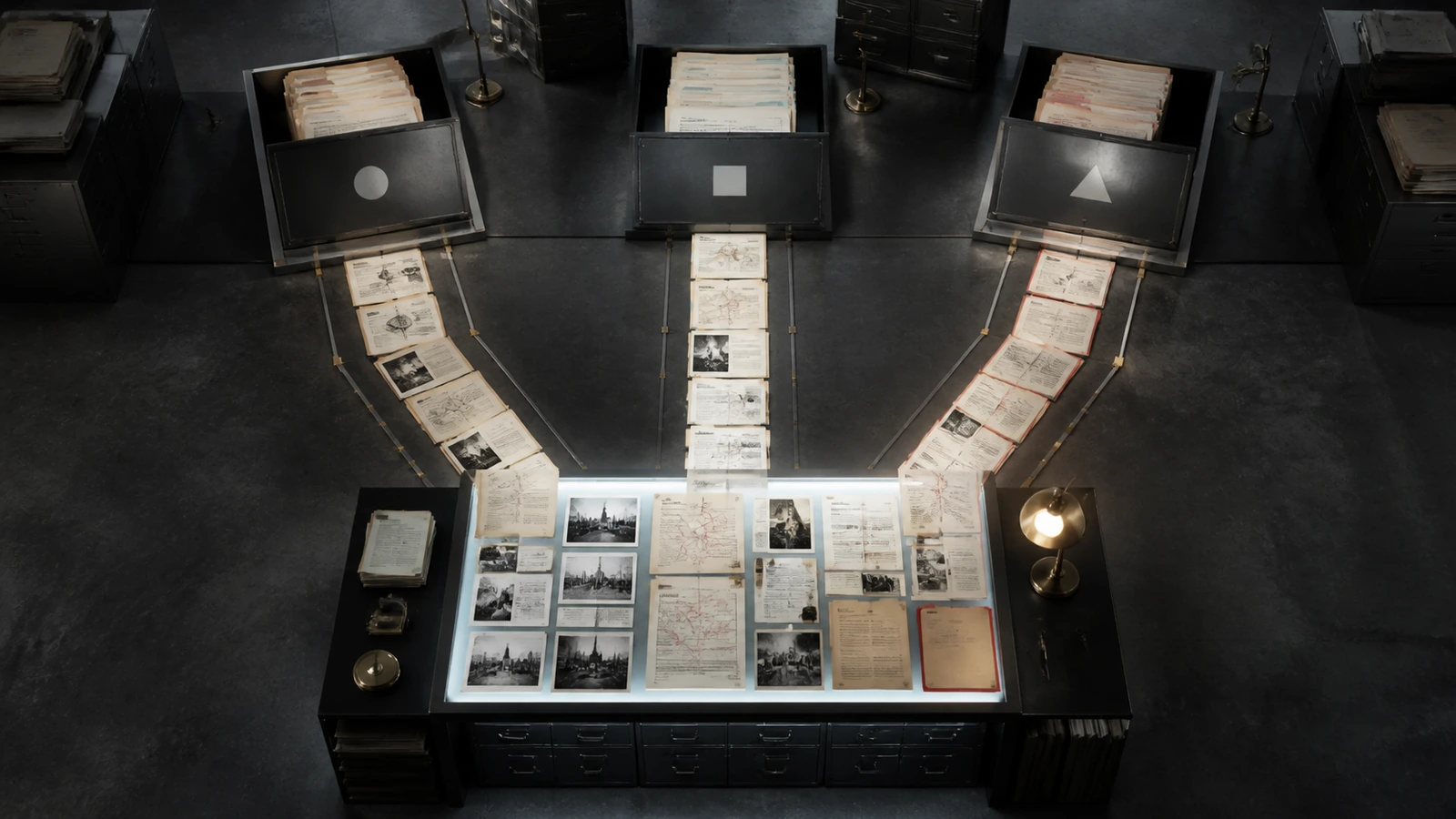
Hugin has been publishing one public event in three different forms and asking the reader to perform the join.
The case file held the durable chronology. News held the dated receipt. Commentary held the operator's method and judgment. All three were useful, all three were public, and all three lived behind different doors.
The August 11 Field Edition begins with a filed reading order: the newest Commentary entry as the lead, the two newest News receipts, and the newest Case file beside them. Those records come from the same public feed that drives the terminal; the edition is a front page, not a second editorial inventory.
Below it, the evidence terminal remains the common reader behind Desk, Cases, News, and Commentary. Each route still opens on the channel the reader asked for. The room, the controls, and the source posture no longer change just because the entry door did.
The reader should not have to be Hugin's database join.
One desk does not mean one kind of record
The terminal keeps three channels because they do three different jobs:
- Cases are durable public-record dossiers. Their cards carry anchor, official-source, and timeline counts; their source side opens a verification packet and leads into the full case file.
- News answers what changed on a specific date. Its cards carry reading time, receipt count, source links, and the evidence-posture note attached to that report.
- Commentary is Hugin's field notebook. It can explain a method, admit an interface failure, or make an argument, but the card identifies it as commentary and keeps the operator's judgment from inheriting the authority of a cited agency document.
Select a card once and the desk opens its brief. Select it again and the card turns to the source side: caveat, record lanes, source receipts, primary-source path, and full-record path. That second face is not hidden fine print. It is the other half of the record.
Connections are cues, not conclusions
The desk can place a related record beside the selected one. The wording is deliberately narrow: a cue to check, not a conclusion.
The strongest connection is now an explicit one. When one Hugin record cites another in its source links, the terminal files that pair ahead of a match based only on shared words. That is why this news entry names the case round and Journal entry below: the relationship is authored, visible, and available to the same source-link parser that publishes the receipts.
Shared language can still nominate a pair for review. A daily desk rank can still decide that a cross-channel candidate is worth a reader's attention. Neither can decide that the pair corroborates a claim. The public desk synthesis record exposes the cue, its generation mode, and its guardrail instead of letting an unseen recommendation become editorial authority.
The August 11 case round is the useful test. Five GAO receipts now sit where they belong in the federal improper-payments chronology, while four CFPB, FTC, and DOJ receipts now sit in consumer protection. The records share themes of oversight and enforcement. They do not share one evidentiary badge:
- an agency-reported improper-payment estimate is not a fraud finding;
- a modeled fraud range is not a count of detected loss;
- an agency warning about its complaint dataset limits aggregate analysis but does not establish misconduct by a company or consumer;
- an entered stipulated order creates obligations without turning disputed allegations into trial findings;
- a non-prosecution agreement is not a conviction.
The desk is allowed to bring those records near one another. It is not allowed to erase the sentences that keep them different.
The Field Edition integrity pass
Today's smaller changes protect the same rule.
The newest work is filed before it becomes a deck. The Field Edition gives the latest Commentary note, two News receipts, and one Case file a stable reading order above the interactive terminal. It brings the three forms into one view without giving them one label.
The case desk now publishes its own integrity ledger. Twelve deterministic checks separate hard wiring failures—missing builds, duplicate IDs, empty or dangling source references—from editorial prompts about unused anchors and date coverage. The human page, JSON, and Markdown carry the same content hashes and the same limit: passing these checks does not make the corpus complete or independently verified.
Every channel now carries a direct route. The terminal is a catch-up surface, not a substitute for a dedicated research index. The active channel links to its stable Cases, News, or Commentary entry route instead of making a reader infer the path from the horizontal deck.
The three channel selectors now behave as a real keyboard tab set. Only the active tab sits in the ordinary tab order. Left and right arrows move between channels; Home and End move to the first and last. A unified public reader that requires a mouse is not unified.
Journal artwork now enters the sitemap with the article. News already published a reliable visual discovery path. Commentary now exposes its own lead image rather than making search and indexing surfaces fall back to a generic card. The distinction between channels remains visible outside the site as well as inside it.
These are not four unrelated polish items. They make the shared desk honest about its limits: it must be navigable, it must expose a stable channel path, and it must publish the same record cues to machines that it shows to people.
What the desk still asks of the reader
One workspace can remove navigation labor. It cannot remove judgment.
A reader still has to open the receipt, read the caveat, notice whether two links come from one institution or independent institutions, and decide whether the connection is material. A source count is inventory, not a truth score. An official page can establish what an agency reported without proving that the agency's underlying estimate is complete. A related-record cue can surface a question without answering it.
That division of labor is the Field Edition's operating promise: Hugin should assemble the file, show its joins, and carry its limits forward. The reader should do the judging.
Source links
- Hugin Evidence Terminal
- Hugin case room
- Hugin newsroom
- Hugin Commentary
- Hugin public desk synthesis record
- Hugin authored content API
- Hugin civic case-files API
- Hugin civic case integrity ledger
- Hugin civic case integrity JSON
- Hugin: nine official receipts enter two case timelines
- Hugin Journal: I kept making the reader assemble the record