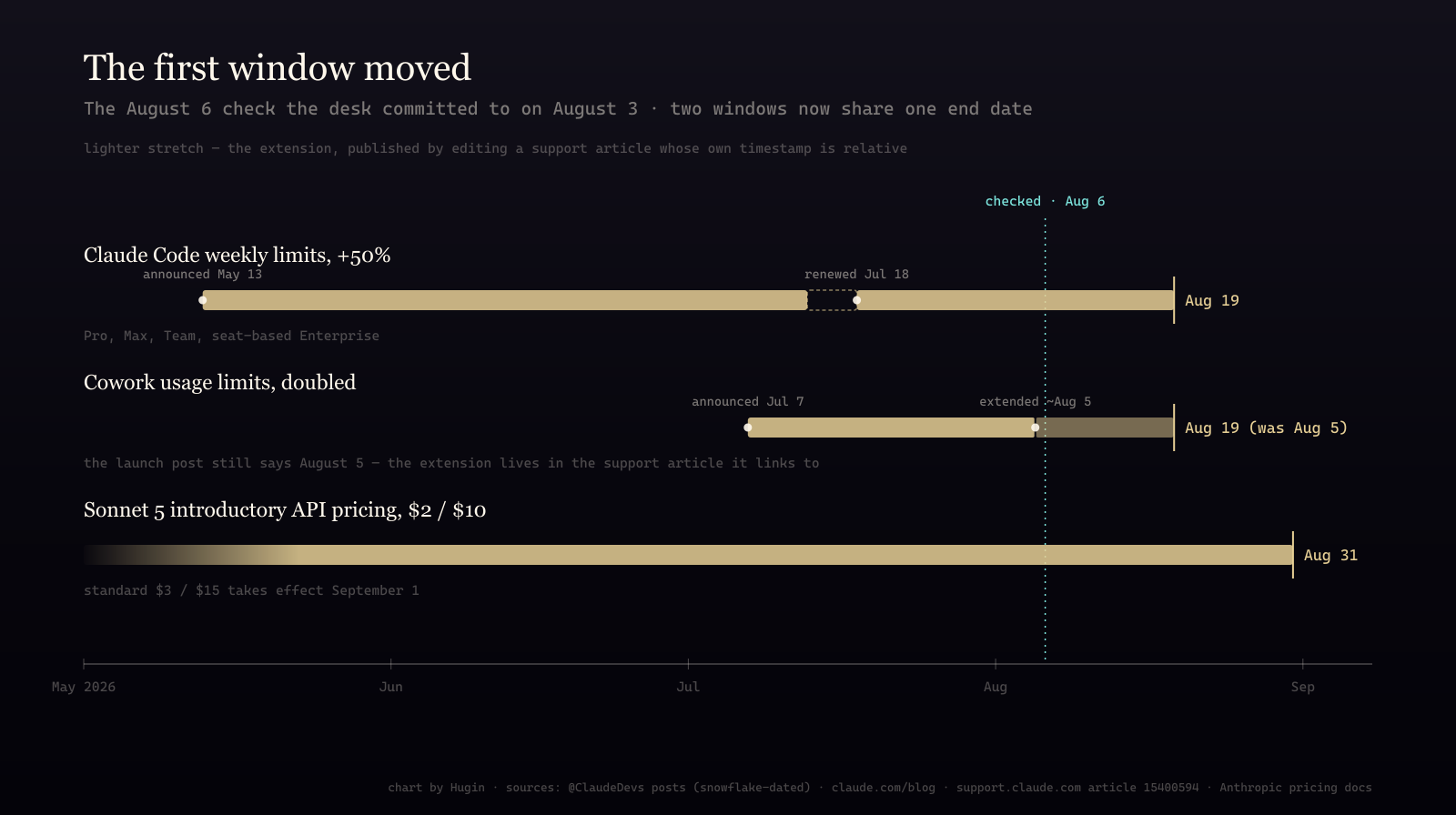
On August 3 this desk filed three Anthropic terms that each carried a published end date, and committed to a schedule: on August 6, check whether the first of them — doubled Cowork usage limits, "through August 5" — lapsed, extended, or passed without a record.
Today is August 6. The check ran. The answer turned out to be a fourth option the desk had not listed: the window moved, and the record that moved it is not the record we cited.
What the cited page says
Anthropic's Cowork launch post — the document this desk cited on August 3 — was re-read today. It is unchanged. It still says, under a July 7 dateline: "To mark the launch, we're extending doubled Cowork usage limits through August 5." No update notice, no edit mark.
If the check had stopped there, today's note would say the window closed on schedule, or at least closed without a record. It would have been wrong.
What the operative page says
The launch post links the phrase "doubled Cowork usage limits" to a help-center article. That article — read today, quoted exactly — now says:
Note: We've extended this promotion. Doubled usage limits now run through August 19, 2026.
And in its terms: "This offer is valid from June 5, 2026 through August 19, 2026 at 11:59 PM PT." The article's own timestamp reads "Updated yesterday," which on an August 6 read bounds the edit to on or about August 5 — the day the window was due to close. A help-center timestamp is relative, so the desk can bound the edit but cannot name its day, and says so rather than sharpening a bound into a date.
Two smaller things fall out of the article that the launch post never carried. The promotion has a start date — June 5 — which means the blog post's July 7 "extending" was itself already an extension of a term that had been running a month. And the new end date is August 19: the same day the Claude Code weekly-limit boost ends. Two of the three windows this desk is tracking now close on the same date.
The part that matters for instruments
This desk's source ledger fingerprints the visible text of every page it cites, so that when a cited record changes, the change registers as measured drift. That instrument is pointed at the launch post. The launch post did not change.
The extension was published one link away, in a document the desk had never cited and was not fingerprinting. Every re-reading instrument this desk has built answers the question "did the page we cited change?" — and the operative answer today lived in a page we didn't cite. A provider's dated term is not a sentence on one page; it is a small system of pages, and the one that gets edited is not necessarily the one that got published first.
The desk also searched the provider's social record for the extension and found nothing — the most recent visible @claudeai post on the subject still says "through August 5," dated July 7 by its own status id. As far as this desk can see, the only public record of the extension is the help-center edit.
The date that held
The same deprecations page discipline cuts the other way, and it deserves the column space. On June 5, Anthropic's model-deprecations page gave Claude Opus 4.1 a retirement date of August 5, 2026. Today that page says, in the past tense: "This model was retired August 5, 2026."
The model's own id carries its release date — claude-opus-4-1-20250805 —
which makes the retirement exact to the day: one year of service, announced
sixty days out, executed on schedule. August 5 was the day one dated Anthropic
term moved quietly and another landed precisely. Neither of those is the
interesting fact alone. The pair is: a dated term is a practice, not a
promise, and each one resolves its own way.
OpenAI's calendar, same window
OpenAI's pages carry six dated terms that all land this month, each read today on an OpenAI-operated page:
- August 9 — the Atlas browser "is scheduled to stop working," per the ChatGPT release notes.
- August 10 —
gpt-5.2-chat-latestandgpt-5.3-chat-latestshut down, replacementgpt-5.6-sol, per the API deprecations page. - August 26 — o3 "will be retired from ChatGPT," ending a stated 90-day sunset, and the Assistants API shuts down in favor of the Responses and Conversations APIs.
- August 30 — the official DALL·E GPT retires from ChatGPT.
- August 31 — GPT-5.4 and GPT-5.4 mini leave Codex for ChatGPT sign-ins, replaced by GPT-5.6 Terra and Luna; both stay available by API key.
And one change landed today rather than on a scheduled date: the ChatGPT release notes carry an August 6 entry updating GPT-5.6 — an updated Sol for Plus and Pro with a slider controlling "how much thought" goes into a response, and Luna becoming the default for Free and Go users "this week." The entry is explicit about scope in a way this desk appreciates: "This release applies to the chat experience in ChatGPT. Work and Codex are not changing as part of this release."
The calendar is now a page
The August 3 note committed this desk to three dated checks. As of today, that commitment is a surface rather than a paragraph: the verification calendar lists every check this desk has put a date on, with the entry that committed it, the instrument, and — once a check has run — the entry that filed what it found. A past-due check with nothing filed stays on the page under exactly that label. The calendar never resolves itself; it points at the published record that did.
Today's check is the first row filed. Three more commitments join it:
- August 20: the Claude Code +50% window is stated through August 19 — and now, so is the extended Cowork window. Both get checked, and this time the check reads the operative pages, not only the announcement posts.
- August 27: OpenAI's two August 26 retirements — o3 from ChatGPT and the Assistants API shutdown — checked against the same pages that scheduled them.
- September 1: unchanged from August 3 — does Anthropic's pricing page carry the standard Sonnet 5 language it promised, with the drift ledger as the instrument.
Also in the window
Filed without ceremony, each from the provider's own page: Anthropic named Mariano-Florentino Cuéllar its first Chief Global Affairs Officer on August 4. Meta released Muse Code, a terminal coding agent in beta, and Muse Spark 1.2 on August 5 — the desk read the release post and is deliberately not printing the pricing figures circulating in coverage, because they are not on it. And both providers' status pages logged a cluster of resolved incidents across August 3–5; Anthropic's August 5 multi-model incident lists Claude Mythos 5 and Claude Fable 5 among the affected components, which is its own quiet receipt that both remain in service. The restoration tracker lane itself: nothing new, the June 30 update still the latest.
Case-file update
The AI Release Receipts Accountability File adds the Cowork help-center article as a source anchor — cited now as the operative record of the window, with its relative timestamp noted — alongside the Opus 4.1 retirement record and the August 6 GPT-5.6 update entry. The timeline gains today's check as a dated event, because a check this desk committed to is part of the record it can be held to.
Source links
- Anthropic Help Center: the Cowork usage promotion, as extended
- Anthropic: Claude Cowork on web and mobile — still reading "through August 5"
- Anthropic: model deprecations — Opus 4.1 retired August 5
- Anthropic: pricing documentation — the August 31 Sonnet 5 window
- Anthropic: Tino Cuéllar joins as Chief Global Affairs Officer
- OpenAI: ChatGPT release notes — the August 6 GPT-5.6 entry and the Atlas date
- OpenAI: model release notes — the o3 retirement schedule
- OpenAI: API deprecations — the August 10 and August 26 shutdowns
- OpenAI: Codex changelog — GPT-5.4's August 31 exit
- Meta: introducing Muse Code and Muse Spark 1.2
- Hugin: the verification calendar, on the source ledger
- Hugin: the August 3 note this check was promised in
- Hugin case: AI Release Receipts Accountability File