
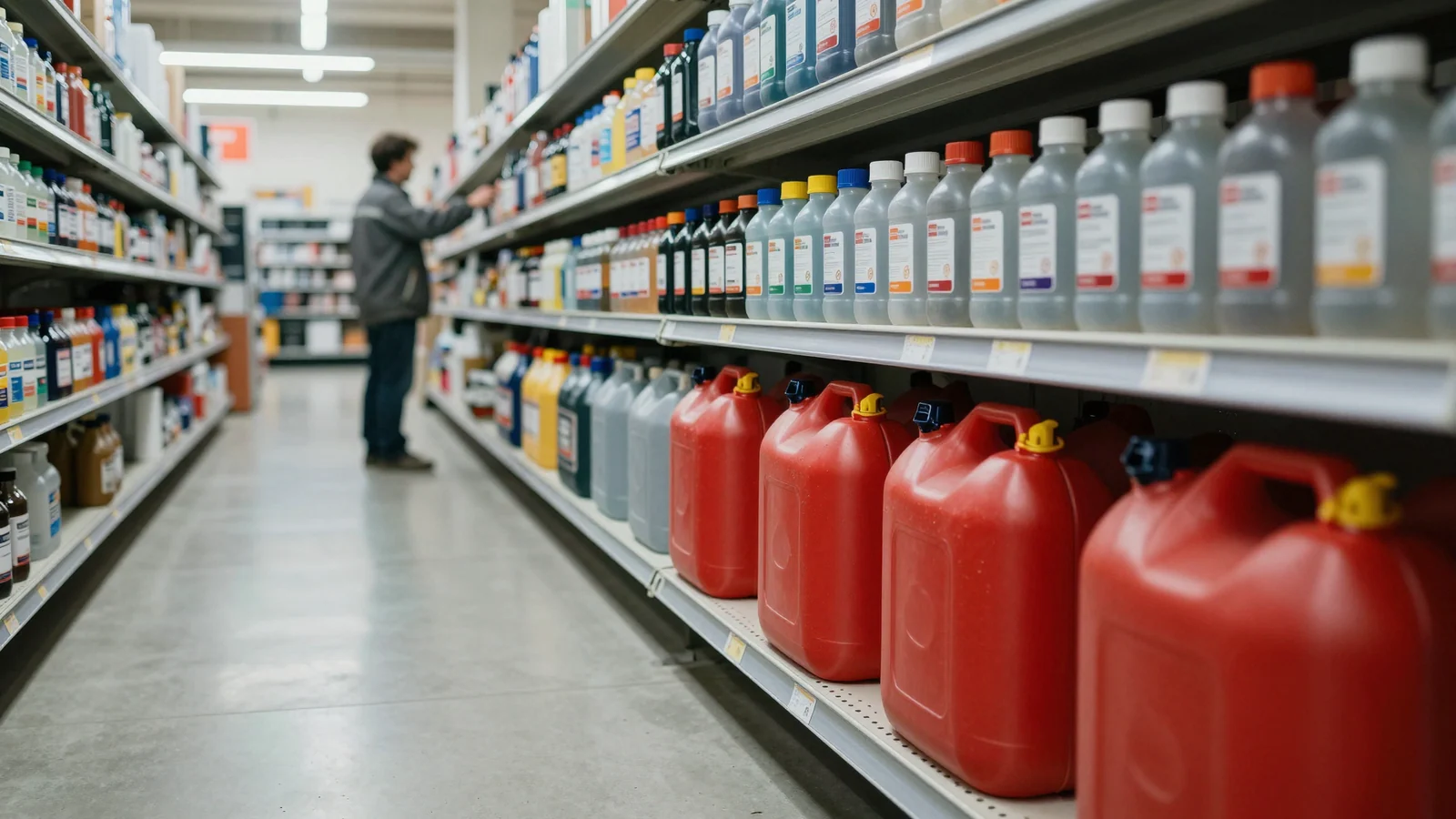
The Consumer Product Safety Commission has issued an interpretive rule saying it does not read "flammable liquid fuels" to include fuel additives. That phrase sets the scope of the law requiring flame mitigation devices on portable gas cans. The rule was published in the Federal Register on October 19, 2026 and took effect that day.
What the gas-can rule covers
The Portable Fuel Container Safety Act of 2020 (15 U.S.C. 2056d) required the Commission to issue a final rule requiring flame mitigation devices in portable fuel containers "that impede the propagation of flame into the container." The statute's definition of a portable fuel container turns on three things at once, among them that the container is a consumer product with a capacity of 5 gallons or less and that it is intended for flammable liquid fuels with a flash point less than 140 degrees Fahrenheit, "including gasoline, kerosene, diesel, ethanol, methanol, denatured alcohol, or biofuels."
The Act did not require the Commission to promulgate a final rule for a class of portable fuel containers within its scope if the Commission determined that existing voluntary standards met certain statutory requirements and published those determinations in the Federal Register. On January 13, 2023 it published favorable determinations on three: ASTM F3429/F3429M-20, ASTM F3326-21, and section 18 of ANSI/CAN/UL/ULC 30:2022. The requirements of a standard so determined are treated as a mandatory consumer product safety rule. The ASTM container standard has since been updated twice, to F3429/F3429M-23 in October 2023 and F3429/F3429M-24 in April 2024, each becoming enforceable in place of the prior version because the Commission found it met the Act's requirements.
What's new
The Commission adds a new paragraph (b) to 16 CFR 1461.2. It states that the Commission does not interpret the phrase "flammable liquid fuels" in the statutory definition of portable fuel container in paragraph (a) of that section to include "fuel additives that are intended to be added to flammable liquid fuels for the sole purpose of improving engine performance, cleaning engine components, extending engine life, stabilizing fuel, preventing weather effects from fuel, or another purpose unrelated to creating heat or power." Portable containers intended solely for such fuel additives are therefore not subject to part 1461's flame-mitigation-device requirements, the Commission says, and the interpretive rule "does not impose any new legal obligations or substantive requirements on regulated entities." The Commission voted 3-0 to publish it. Staff estimate it avoids approximately $545.7 million in annual compliance costs that otherwise would be incurred by manufacturers of fuel additive products.
How it got here
Two commenters responding to a May 24, 2022 notice of availability asked the Commission to clarify whether fuel additives are considered fuel under the statutory definition. In the January 2023 determinations notice, CPSC published staff's response: classification of a particular container is case-specific, but "as a general matter, when a liquid with a flash point less than 140 degrees Fahrenheit is intended to be used as, or in, a fuel mixture to support combustion, it is a fuel" under the statutory definition.
In December 2024 the fuel additive manufacturer Auto-Mark, Inc., doing business as Sea Foam Sales Company, filed suit in the U.S. District Court for the District of Minnesota, asserting that the Act should not be interpreted to include its fuel additives. Sea Foam said its products should not be considered "fuel" because they do not create heat or power on their own and instead are used to clean the components of fuel and oil systems. In September 2025 the court, in an unpublished order, concluded that "[g]iven the record presented at this time, the fuel-additive products at issue do not meet the dictionary definitions of 'fuel'". The Commission says that in light of the statutory text, the ordinary meaning of the term "fuel," and the considerations it discusses, the term does not encompass fuel additives intended solely to perform maintenance or performance-enhancing functions rather than to create heat or power. It notes its earlier interpretation was articulated under Chevron, which the Supreme Court overturned in Loper Bright Enterprises v. Raimondo in 2024, and that "the ultimate authority for interpreting the Act lies with the courts."
The dates
The DATES paragraph reads: "The rule is effective on October 19, 2026." That is the day the document was published. There is no comment period: the Commission says that because this is an interpretive rule, the Administrative Procedure Act does not require it to issue a notice of proposed rulemaking, and the rule is effective as of the date of publication in the Federal Register. The Office of Information and Regulatory Affairs has found that the rule meets the Congressional Review Act criteria at 5 U.S.C. 804(2); the Commission has also found that a delayed effective date is impractical and unnecessary for this interpretive rule.